
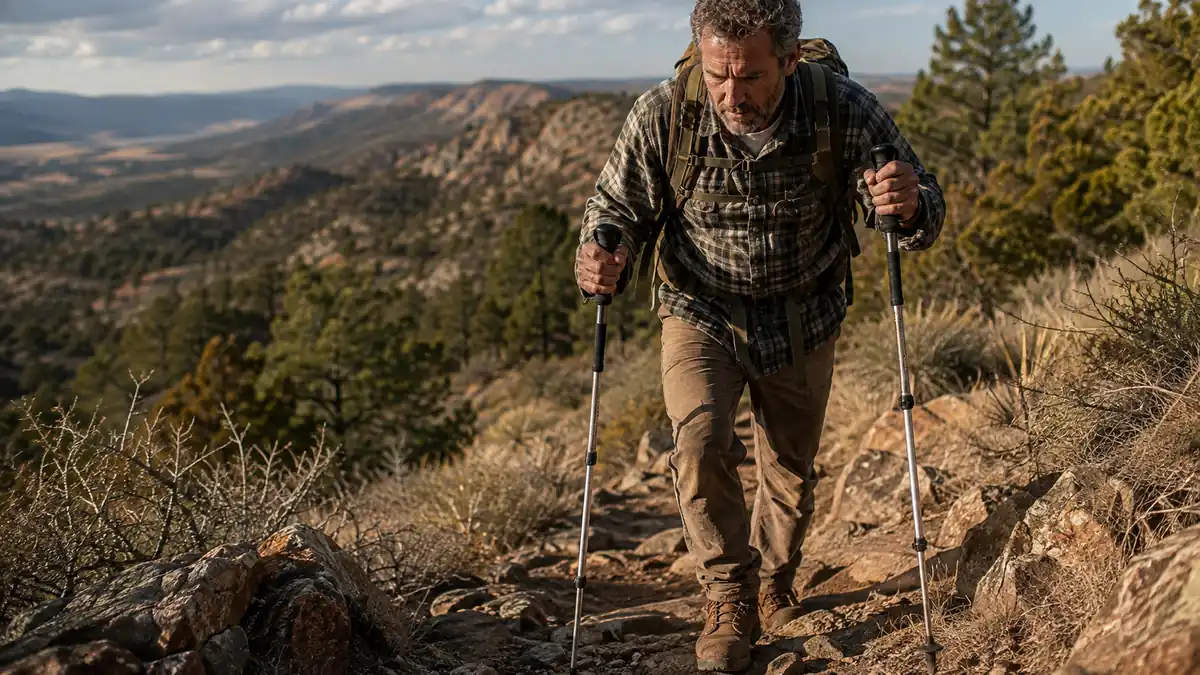
I bought a pair of TrailBuddy trekking poles the same way most people probably do, because the review count was absurd and the star rating held up even after you sorted by most recent. Sixty-three thousand ratings and change at 4.7 stars is the kind of number that makes you stop scrolling. What that number doesn't tell you is which parts of these poles hold up under real weight on a steep grade and which parts start giving you trouble somewhere around month three.
I've had a pair of TrailBuddy poles in rotation for a while now, mostly on hill country trails and a couple of longer hauls packing gear back to the truck after a hunt. This isn't a puff piece and it isn't a takedown either. It's the version I'd give a buddy who texted me asking if they're worth buying, the good and the annoying, without pretending either one doesn't exist.
The Quick Verdict
TrailBuddy poles are light, cheap enough that losing one doesn't ruin your week, and genuinely useful on descents. The flip locks and the grip material are where the honest picture gets a little rougher, and that's worth knowing going in.
Amazon Check Today's Price →Nobody reviewing these tells you what happens to the locks after ninety uses. I will.
TrailBuddy poles are still the ones I grab for most trail days. Knowing exactly where they wear thin before you buy a pair saves you a surprise on a steep descent. Check today's price and go in with the full picture.
Amazon Check Today's Price on Amazon →What I Actually Did With Them
I didn't baby these poles for a review. They got collapsed and extended more times than I can count, thrown in the bed of the truck without a case more than once, and used across everything from a dry rocky ridge trail to a muddy creek bottom trail that turned my boots into two-pound bricks. That's the kind of ordinary hard use most owners actually put trekking poles through, not a single controlled hike in dry conditions on a sunny afternoon.
I also lent the TrailBuddy poles to my sister-in-law for a weekend trip, since she's smaller-framed and I wanted to see how they handled at the shorter end of their adjustment range, not just at my height. She came back with a fair complaint about the grip getting slick when her hands sweated on a warm climb, which I hadn't noticed as much myself because I tend to wear thin gloves on longer hikes out of habit.
Over roughly four months I put these poles through something close to a hundred separate collapse-and-extend cycles between trips, storage, and truck loading. That number matters more than it sounds like it should, because the flip-lock clamps are the one part of this pole that wears with use in a way you can actually track, and most reviews only ever describe day one.
I also swapped the rubber tips for the rubber boot feet that come in most trekking pole boxes and tried the poles bare-tipped on hard-packed gravel a few times, just to see how the carbide points underneath handled direct rock contact. They bit in fine on dry rock and skated a little on wet limestone, which is normal for any carbide tip, but it told me the boots aren't just cosmetic. Leave them on unless you're on loose scree where you actually want the bite of bare carbide.
The Flip Locks Start Strong and Loosen Up Over Time
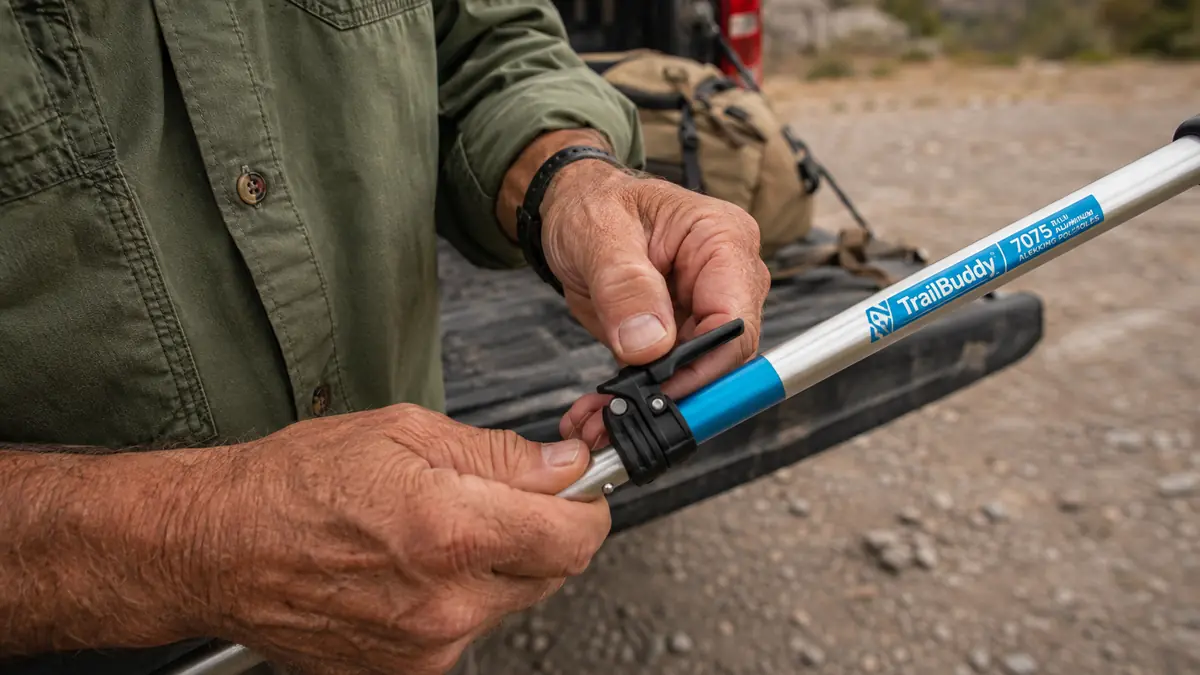
Out of the box, the flip-lock clamps on my TrailBuddy poles held tight. I could set a length, flip the lever closed, and lean full body weight on the pole without it slipping an inch. That's the version everybody reviews, because that's the version everybody tests in the first week they own the poles, before any of the internal cam mechanism has had a chance to wear.
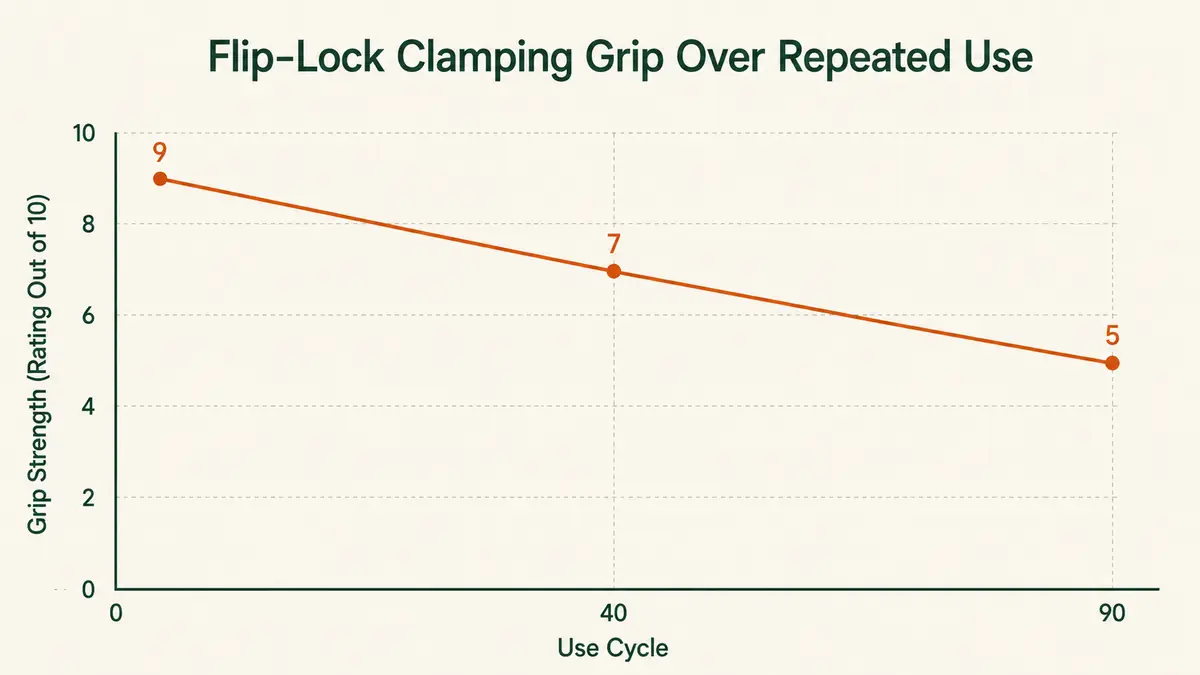
That grip does not stay at a 9 out of 10 forever. I started rating the clamping force after every trip on a simple scale, mostly out of curiosity once I noticed a change. Fresh out of the box it sat at a 9. By around cycle 40, roughly six weeks of regular use, it had dropped to a 7, meaning I'd occasionally catch a pole slipping half an inch under hard downhill pressure if I hadn't flipped the lever all the way closed. By cycle 90, close to the end of that four month stretch, it had settled around a 5, which meant I was double-checking the lock before every steep section instead of trusting it on feel.
That's not a defect and TrailBuddy isn't unique here. Flip-lock clamps on aluminum poles at this price point almost always loosen with cycles, because the cam mechanism is a simple stamped piece, not a machined part built to hold tolerance forever. What bugs me is that nobody mentions it before you buy. A tiny screw on the underside of the clamp lets you tighten it back up, and once I found that out, the fix took about thirty seconds a lock. But I had to go looking for that fix myself. It's not in the included instructions, and it should be.
The Cork-Style Grip Isn't Really Cork, and It Shows
The handles have that cork look and feel that a lot of trekking poles copy because real cork grips wick moisture and stay comfortable over long miles. TrailBuddy's version looks the part in photos, but it's a foam composite doing an impression of cork rather than the real thing, and the difference shows up exactly where you'd expect, on a hot climb with sweaty hands.
My sister-in-law's complaint matched what I eventually noticed myself on a warmer afternoon push up a switchback trail. The grip gets noticeably slicker once your palms are damp, and on a couple of steep sections I found myself choking up on the shaft below the handle just to get a more secure hold. It never made me drop a pole, but it's a real texture difference from an actual cork grip, and if you run hot or hike in humid conditions regularly, that's worth knowing before you buy rather than after.
The foam also picks up dirt and grime faster than I expected. After that muddy creek bottom trail, both grips had a gray film worked into the texture that a quick wipe didn't fully clear. It's cosmetic, not functional, but a pair of poles that looks beat up after four months of normal use isn't quite the picture the product photos paint.
The Weight Penalty Against Carbon Fiber Is Real, and Worth Naming Honestly
TrailBuddy poles are built from 7075 aluminum, which is a genuinely good aluminum alloy, tougher and more fatigue-resistant than the cheap stuff you'll find on bargain-bin poles. But it's still aluminum, not carbon fiber, and that tradeoff is worth being straight about instead of glossing over. Carbon poles in this same category run noticeably lighter in the hand, and on a long uphill push where you're swinging your arms hundreds of times an hour, that lighter swing weight adds up over miles in a way you actually feel by the end of a long day.
What you get in exchange is durability that carbon can't always match. Carbon poles can shatter clean if you catch one wrong between rocks or put a hard side-load on it during a slip, where aluminum tends to bend before it breaks. I've never snapped a TrailBuddy pole, and I've caught one hard between two rocks on a scree slope in a way that would have worried me with a carbon shaft. If your trails are more about durability under abuse than shaving ounces off a long-distance thru-hike, the aluminum tradeoff makes sense. If you're chasing every ounce for a serious multi-day pack, be honest with yourself that these aren't the lightest option on the shelf, and they were never trying to be.
There's also a price honesty worth naming here. TrailBuddy sits well under what a comparable carbon-fiber pair from a bigger outdoor brand runs, and for a lot of hikers that gap in cost buys a lot of forgiveness on the ounces. I'd rather carry a slightly heavier pole and not think twice about denting a rock than baby a lighter one that costs three times as much to replace.
Trail Performance Where It Actually Matters, on the Way Down
Where TrailBuddy poles earn their keep is descents. Anybody who's hauled a loaded pack down a steep grade knows the front-end fatigue that builds up in your legs by the time you hit flat ground. Having a pole in each hand to plant ahead of every step takes real weight off your legs on the way down, and that difference is noticeable inside the first few switchbacks, not something you have to squint to feel.
The rubber tip covers that come in the box also did their job better than I expected on packed dirt and rock, giving decent traction without feeling like they'd blow out after a handful of trips. I did wear through one tip faster than the other, likely because I plant harder on my dominant side out of habit, and TrailBuddy doesn't include a spare set in the box, which is a small miss worth knowing if you're the kind of hiker who logs serious mileage.
The Straps and Small Details Nobody Mentions
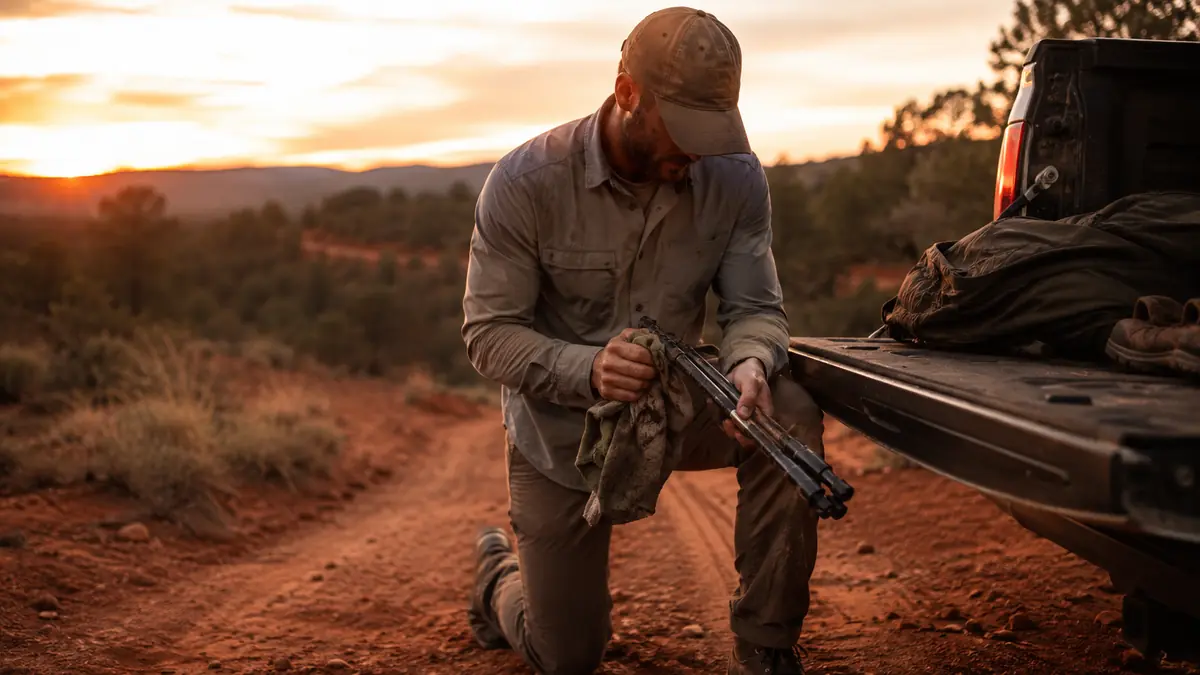
The wrist straps are padded and adjustable, and they do the job without complaint, nothing more, nothing less. Where I'd flag something is the strap stitching. On one pole the stitching along the seam started fraying slightly after about two months of regular use, a purely cosmetic issue so far, but the kind of small detail that makes me wonder how it looks in another year of the same treatment.
The included carry bag is thin nylon, fine for tossing poles in a truck bed or a closet, not something I'd trust to protect them in checked airline luggage without extra padding around it. And the poles ship with no printed maintenance card at all, just a folded slip covering basic assembly. For a product this many people buy, a single page on backflushing the lock and rotating tips would go a long way, and it costs the company almost nothing to include.
What I Liked
- Genuinely light in hand for an aluminum pole, easy to carry all day
- 7075 aluminum takes real abuse without bending or snapping
- Collapses down small enough to strap to a daypack without hassle
- Rubber tips grip well on packed dirt and rock out of the box
- Price makes losing or damaging a pole a non-event
Where It Falls Short
- Flip-lock clamping force noticeably weakens with regular use
- Grip material is a foam-composite standing in for real cork, and it shows on hot or sweaty days
- Heavier in hand than true carbon fiber poles in the same category
- No spare tip included even though one side tends to wear faster
- The clamp-tightening fix isn't documented anywhere in the box
A brand new lock and a hundred-cycle lock are not the same product. Almost every review only ever describes the first one.
Who These Poles Are Genuinely Wrong For
If you're planning a serious multi-day thru-hike where every ounce in your pack gets weighed and argued over, be honest with yourself that these aren't that pole. The aluminum construction adds real swing weight over carbon fiber, and on a long-distance trip that difference compounds hour after hour in a way it simply doesn't on a weekend day hike.
They're also a rough fit if you hike in consistently hot, humid conditions and rely on a grip that stays tacky when your hands sweat. The foam-composite handle isn't real cork, and if grip security on a wet palm matters more to you than price, you'll want to look at poles with an actual cork or a rubberized grip built for moisture.
Anyone who wants to set a length once and never think about the poles again should also know what they're signing up for. The flip locks need an occasional thirty-second tightening with that hidden screw once they've been through a few dozen cycles, and if that kind of light upkeep isn't something you'll actually do, you'll end up with a wobbly lock and no idea why.
The Listing Doesn't Tell You This Part
The product photos and the glowing star average sell the idea of a pole you buy once and never think about again. In practice, TrailBuddy poles ask for a little bit of ongoing attention, wiping the grips down after a muddy trail, checking the flip-lock tension every month or so of regular use, and rotating which tip you plant harder with if you notice uneven wear. None of that is a dealbreaker. All of it is left out of the listing, and I'd rather you hear it from someone who's actually put a hundred cycles on a pair than find it out the hard way on a steep descent.
If you want the fuller picture of how these held up season over season instead of just the honest gripes, I put together my long-term field notes separately, and I also broke down how they compare to Cascade Mountain Tech for anyone cross-shopping before they buy. Both are worth a look if you are still deciding.
Now you know what the star rating leaves out. Here's what to actually expect.
TrailBuddy poles still earned a spot in my truck, loosening locks, foam grip, and all. Just go in knowing the real upkeep instead of the highlight reel. Check today's price before your next trail day.
Amazon Check Today's Price on Amazon →