
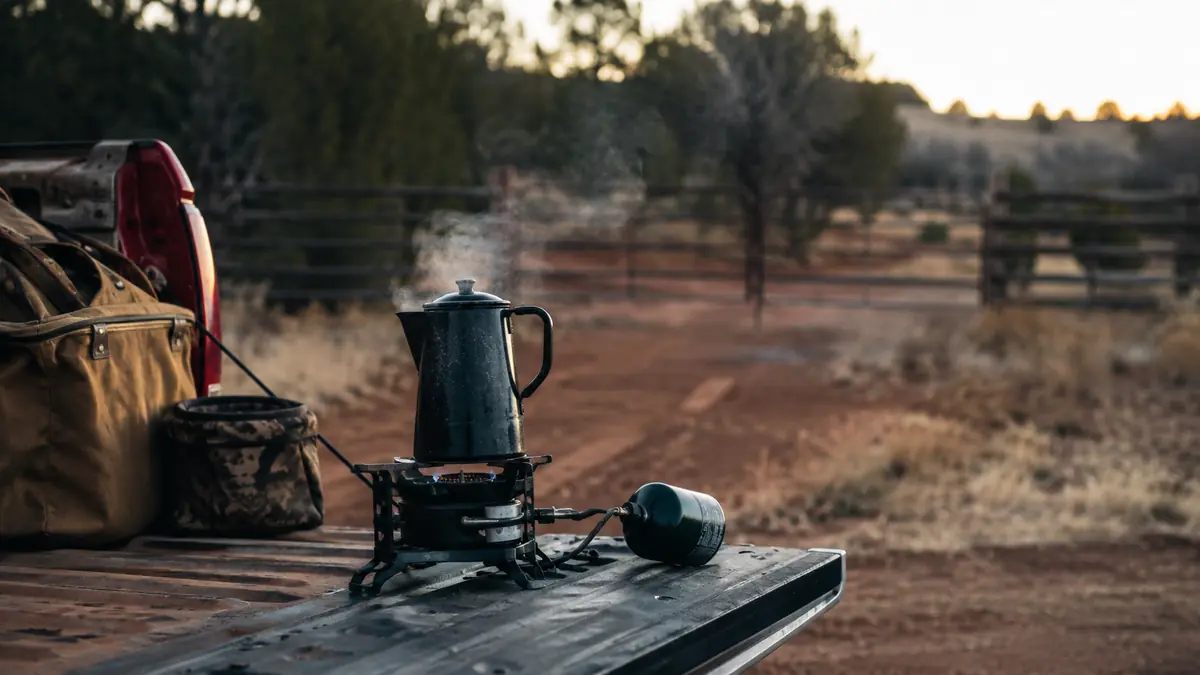
If you want the short answer before I get into why: the Gas One GS-3400P is the stove that rides in my truck bed on every single trip I take, whether that's a morning of scouting, a weekend at deer camp, or a Tuesday drive out to check a fence line where I know I'll want coffee before I'm done. The Coleman Triton is the stove that lives in the shed and comes out when I'm cooking for a full camp of guys and I need two burners going at once, eggs on one side and a skillet of potatoes on the other. Both of these have earned a place in my setup. They just don't earn it doing the same job.
I've had the Gas One for a couple of years now, and it's the stove I reach for more than anything else I own, mostly because it runs on propane or butane, whichever canister I happen to have rattling around in the truck. That flexibility matters more than people give it credit for until they're standing at a gas station forty miles from the nearest outfitter with the wrong size canister and no way to cook. The Coleman Triton is a bigger animal, a two-burner propane cooktop with folding legs and a windscreen built into the design, and it's meant for a different kind of trip entirely, the kind where you're setting up a base camp for a few days and actually feeding people instead of just yourself.
I didn't pull either one of these off a spec sheet to write this up. The Gas One has been strapped down in the bed of my truck since I bought it, and it's cooked more solo breakfasts and quick lunches than I could put a number on. The Triton belongs to the same camp setup I've been running with three or four buddies every deer season for years now, the same guys who show up expecting real food and not a granola bar standing up by the tailgate. I've run both of them side by side on plenty of mornings just to see which one had water boiling first, and honestly it's closer than you'd think, the real difference shows up in how each one fits the job you're actually doing, not in raw speed.
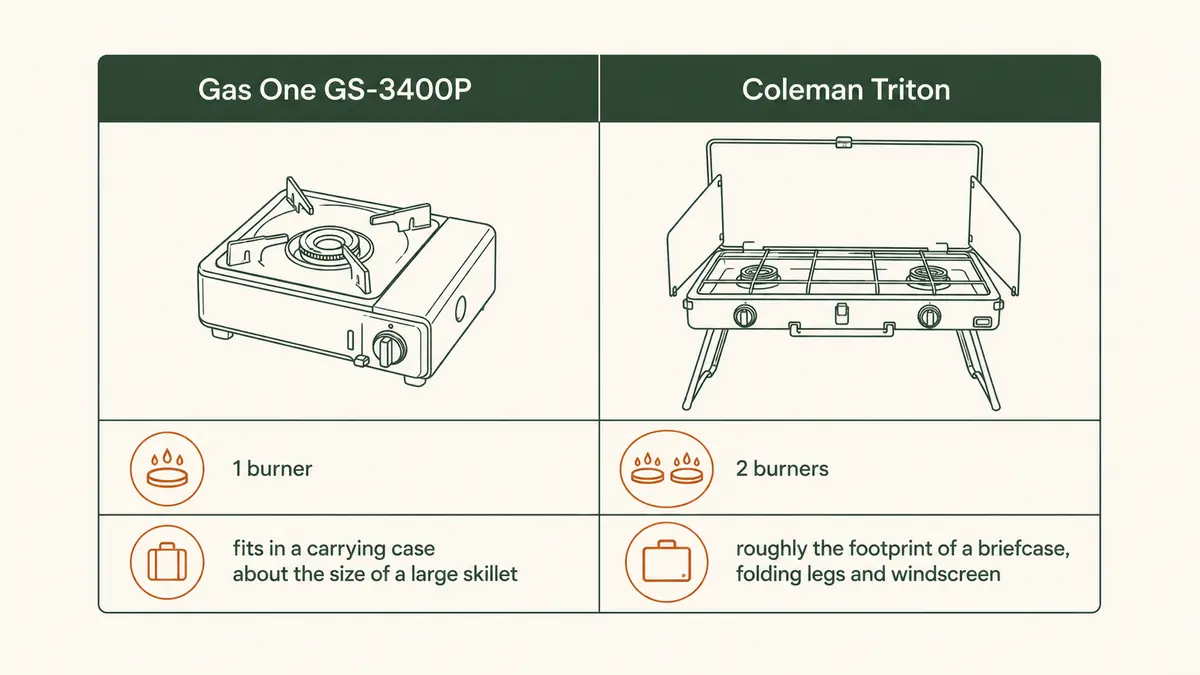
| Gas One GS-3400P | Coleman Triton | |
|---|---|---|
| Fuel Type | Runs on either propane or butane canisters, patented dual fuel design | Propane only, standard 16 oz canister or hose to a bulk tank |
| Burners | One burner | Two burners side by side |
| Portability and Packed Size | Folds into its own hard carrying case, about the footprint of a large skillet, easy to toss on the truck floorboard | Folds flat with legs tucked under, closer to the size of a briefcase, needs its own bag or a spot in the truck bed |
| Wind Performance | No built-in windscreen, does fine tucked behind a tailgate or a rock but struggles out in the open on a gusty day | Built-in windscreen wraps both burners, holds a flame steady in open, exposed camp settings |
| Simmer Control | Single control knob, fine for boiling water and basic frying, less room to run two dishes at different heats | Independent controls on each burner, easier to hold a low simmer on one side while the other runs hot |
| Cold Weather Behavior | Butane can struggle to light or hold a strong flame once temps drop hard, propane canisters handle the cold better | Propane handles cold mornings consistently, no fuel-switching decision to make |
| Best Use | Solo trips, quick scouting runs, anything where pack space and grab-and-go matter more than feeding a crowd | Base camp cooking, feeding multiple people, longer stays where you're not breaking camp every morning |
Where the Gas One Wins
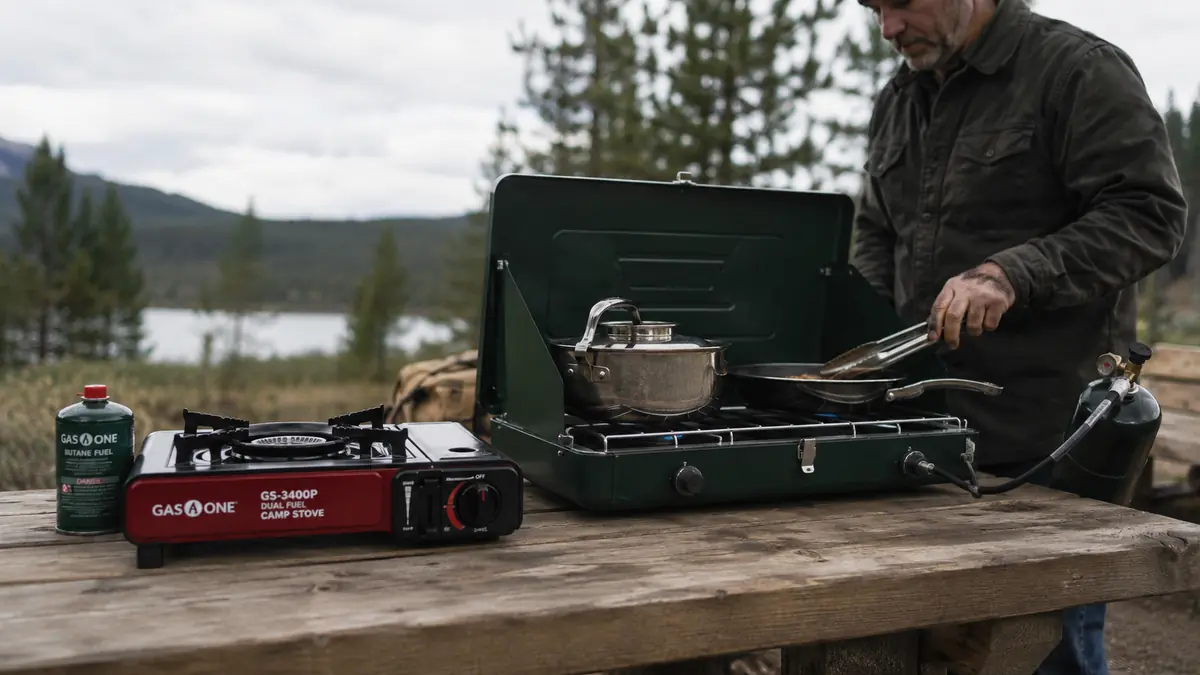
The dual fuel setup is the whole reason I keep reaching for the Gas One over anything else. I don't have to think about which canister I grabbed off the shelf before I left the house. Propane, butane, whichever one's in the truck, it screws on and lights. I've run it on butane canisters I had left over from a fondue set my wife bought years ago, and it worked exactly like it should. That kind of flexibility has saved a trip more than once when I got to the campsite and realized I'd grabbed the wrong size tank.
Size is the other thing. The whole stove folds into its own carrying case, about what you'd expect a large cast iron skillet to take up, and it rides on the truck floorboard or tucks into a corner of a pack without me thinking twice about it. On a morning where I'm heading out before daylight to glass a field before the guys I hunt with show up, I can have coffee going in the time it takes to unfold a camp chair. It's not a stove I plan a trip around, it's a stove that's just always there, which is exactly what you want out of gear you use as often as I use this one.
It's also cheap enough that losing or damaging one doesn't sting the way it would with bigger gear. I've had mine bounce around in a tailgate toolbox for two seasons now and it still lights on the first try every time. For a single guy cooking for himself, or two guys splitting duties on a quick overnight, one burner is genuinely all you need. I've cooked eggs, boiled water for coffee, and heated up canned chili on this thing more mornings than I could count, and it's never once let me down when I needed it. If you want every detail from two years of running it, I put it all down in my full long-term review of the GS-3400P.
Cleanup and upkeep favor the Gas One too, mostly because there's less of it. One burner head means one thing to scrub if a pot boils over, and the whole carrying case wipes down in a couple minutes at the tailgate before I load it back in the truck. I've never had to mess with the fuel line or worry about a hose fitting working loose the way you have to keep an eye on with anything that connects to a bulk propane tank. Less to maintain means less that can go wrong when I'm forty minutes from the truck and just need it to work.
Where the Coleman Triton Wins
The Triton earns its keep the second you're cooking for more than one or two people. Two burners running independently means I can hold bacon at a slow render on one side while I've got a skillet of potatoes going hard on the other, and neither one is waiting on the other to finish. At deer camp with four or five guys expecting a real breakfast before first light, that's not a luxury, it's the difference between everybody eating warm food together and somebody standing around with a cold plate while the second batch cooks.
The built-in windscreen is a real advantage too. I've set the Gas One up in an open field on a windy morning and watched the flame get pushed around enough to slow down a boil. The Triton's windscreen wraps around both burners and keeps the flame where it belongs, even out in the open with nothing to block the wind. If you're camping somewhere without much natural cover, tree line, a truck to duck behind, that built-in shield matters more than it sounds like it would on paper.
It's a bigger commitment to haul, no question. It doesn't fit in a jacket pocket or a small pack, and it wants its own spot in the truck bed or a dedicated tote. But for a base camp setup where you're parked for three or four days and cooking real meals twice a day, that size stops being a downside and starts being the whole point. You're not breaking camp every morning, so the extra bulk just sits there doing its job.
Setup takes longer too, folding the legs out, seating them on flat ground, running the hose over if you're tied into a bulk tank instead of a small canister. That's a couple extra minutes you don't spend with the Gas One, where you're screwing on a canister and turning a knob. On a solo morning that couple minutes feels like real time wasted. Around a full camp where everybody's pitching in on setup anyway, nobody notices.
Tired of Standing Around Waiting on One Burner?
For quick trips, scouting runs, and mornings where you just need coffee going fast, the Gas One GS-3400P is the stove that's always in my truck. Dual fuel, folds down small, lights every time.
Amazon Check Today's Price on Amazon →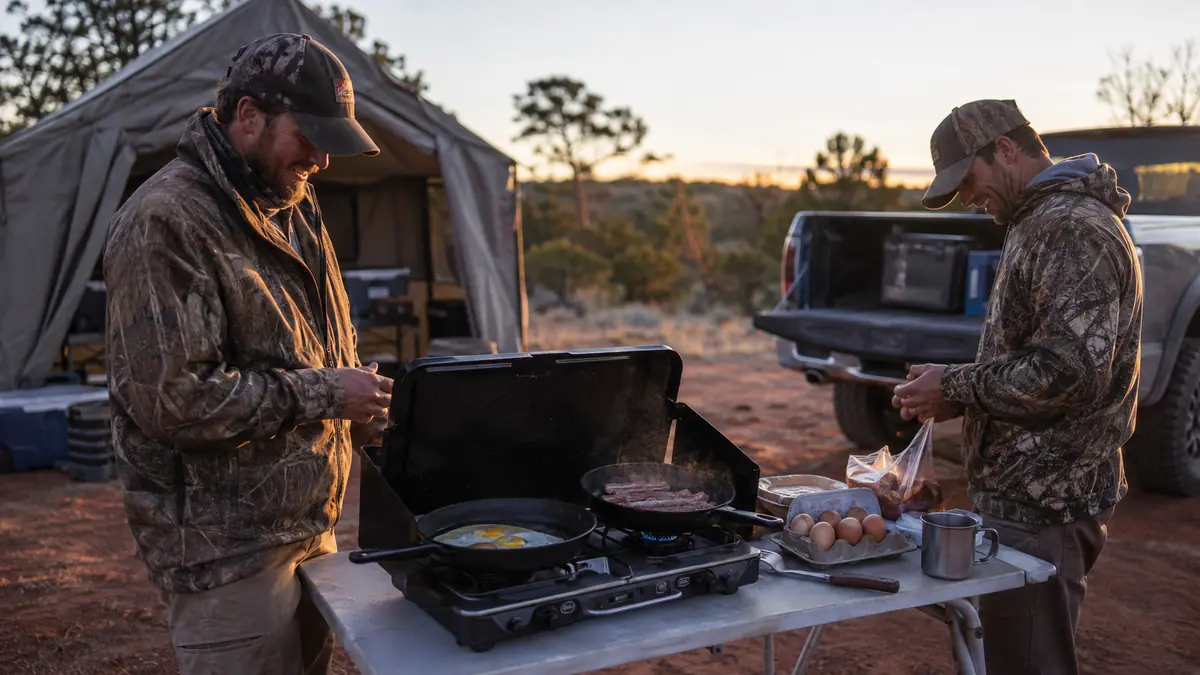
Who Should Buy Which
If you're a solo hunter, a day hiker, or somebody who just wants a reliable stove riding in the truck for whatever comes up, the Gas One GS-3400P is the one to buy. It's cheap, it's small, and it runs on whatever fuel you've got on hand, which counts for a lot when you're the kind of guy who forgets to check the canister before he leaves the driveway. If you're feeding a full camp, running a multi-day base camp setup, or you know you'll be cooking two dishes at once on a regular basis, the Coleman Triton's second burner and windscreen make it worth the extra size.
These two aren't an either-or choice if you're serious about your setup. I actually keep both. The Gas One rides in the truck year-round for anything spur of the moment, and the Triton comes out of the shed specifically for deer camp and any trip where I know ahead of time I'm cooking for a group. Buy the one that matches the trip you actually take most, not the one that sounds more impressive sitting on a shelf. And it's worth checking today's price on the Gas One before you decide, since a stove this useful for the money is hard to argue with once you see what it actually costs to keep in the truck. I laid out the honest breakdown after a dozen trips if you want the warts-and-all version before you commit.
The other thing worth weighing is what happens when it's not the main trip you built the packing list around. If cooking gear is just one line item on a much longer list, rifle, boots, blind, decoys, whatever the day actually calls for, the Gas One doesn't ask you to make room for it the way a bigger two-burner setup does. That's part of why it ends up in the truck even on trips where I never planned to use it. It costs almost nothing in space or attention, so there's no real reason to leave it behind, even for a short overnight where I figure I probably won't cook much of anything.
Bottom line, and I'd tell you this standing at the tailgate: if you want a stove that's always ready, folds down to nothing, and never cares what kind of canister you grabbed on the way out the door, take the Gas One GS-3400P. If you need two burners going for a camp full of hungry guys, the Coleman Triton will carry that weight. Neither one is a bad call. I just know which one is riding in my truck on the next trip out.
The Stove That's Always Ready When You Are
The Gas One GS-3400P runs on propane or butane, folds into its own case, and has ridden in my truck bed on every trip out for two seasons running. Check the current price before your next trip.
Amazon Check Today's Price on Amazon →