
Most of the bucks I've killed in the last fifteen years showed themselves in about twenty minutes of usable light, either that gray window before the sun clears the tree line or that last stretch of dusk when the woods go the color of old iron. That's exactly the window where cheap binoculars fall apart on you. Everything looks fine at ten in the morning. It's four forty in the evening when a bad pair of binoculars turns a legal buck into a gray smudge you can't judge.
I've hunted red dirt country in Oklahoma my whole life, mostly whitetail, mostly from a ladder stand or a fence line where I'm glassing open pasture and cedar breaks at the two times of day deer actually move. If your binoculars can't hold detail in low light, you're not really hunting those hours, you're just standing there hoping. This guide is the checklist I actually run through, and it's the same reasoning that led me to the pair I carry now, the Vortex Crossfire HD 10x42. I'll get into why below, but the short version is that it's built around the same priorities I'm about to walk you through, not around a spec sheet that looks good in a catalog.
None of this is complicated once you know what to look for, but most of the store displays are lit bright enough to make every pair on the rack look identical. You won't find out which binoculars actually hold up until you're standing in a stand at 6:15 in the morning with the sun still a half hour from clearing the horizon. So I'd rather walk you through the checklist now than have you find out the hard way on opening morning.
The binoculars I quit second-guessing at last light
After running two cheaper pairs that turned to mud by 5:30 in the evening, I switched to the Vortex Crossfire HD 10x42. HD glass, a real exit pupil for low light, and a fully sealed waterproof, fogproof housing that's handled every cold, wet morning I've thrown at it.
Amazon Check Today's Price on Amazon →Step 1: Understand exit pupil before you look at magnification
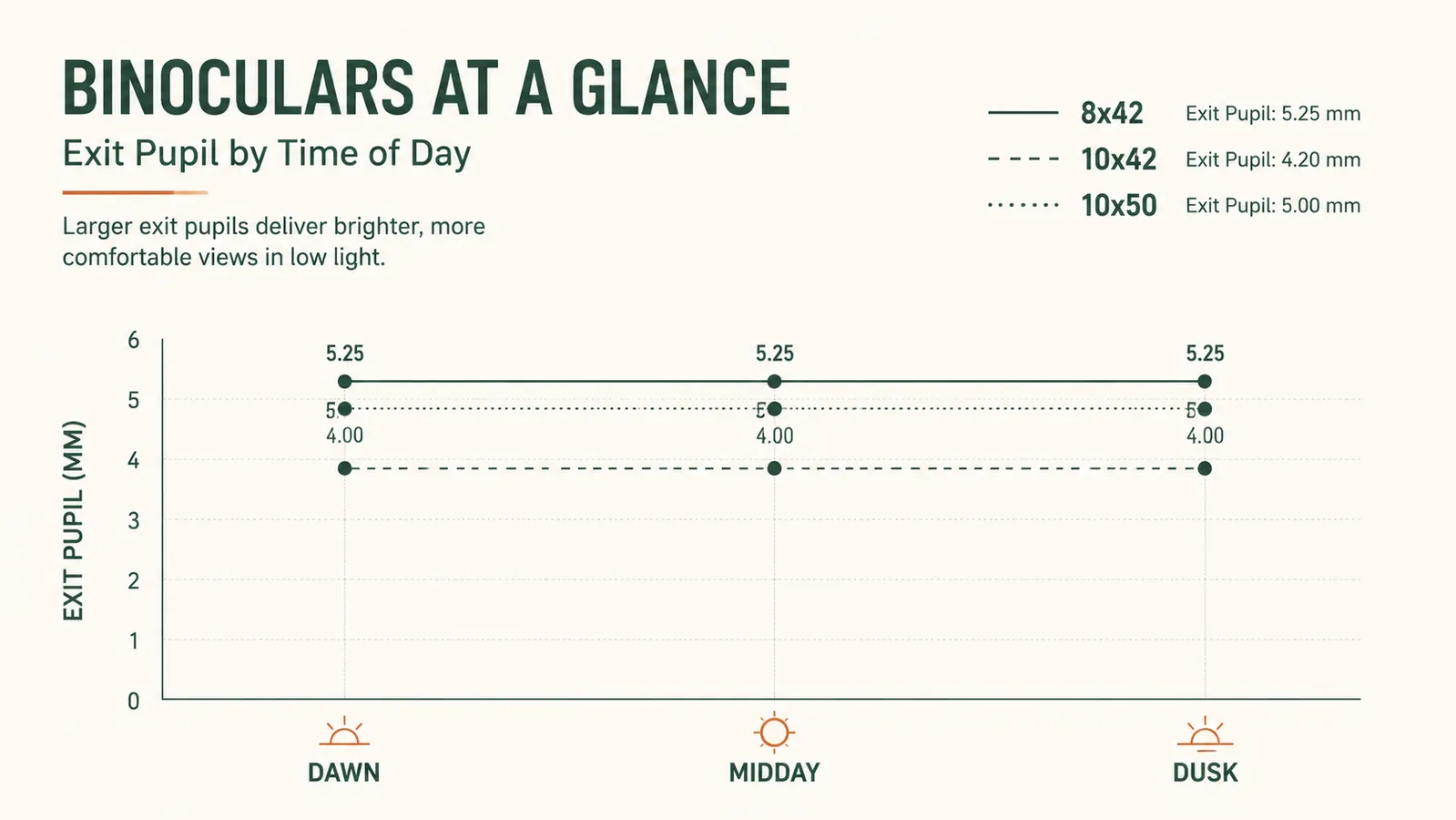
Every hunter walks into a store and asks about magnification first. Wrong question. Magnification tells you how big something looks. Exit pupil tells you how bright it looks, and brightness is what saves you at first and last light. Exit pupil is the objective lens diameter divided by the magnification, and it's measured in millimeters.
A 10x42 binocular has a 4.2mm exit pupil. That number matters because your own pupil dilates to somewhere around 5 to 7mm in low light, depending on your age and how dark it actually is. A binocular with a bigger exit pupil pushes more of that available light into your eye instead of wasting it. This is why I steer people away from compact 8x25 or 10x25 binoculars for hunting. They're light in your pack, but their exit pupil sits around 2.5 to 3mm, and at 5:15 in the evening that's the difference between reading antler points and guessing at them.
The 10x42 configuration is the sweet spot I keep coming back to. Enough magnification to judge a rack at 300 yards across a pasture, enough objective lens diameter to keep the exit pupil in that 4mm range that still works when the light's dropping fast.
You can test this yourself before you ever buy a thing. Stand in your driveway right at dusk, look at a fence post or a tree line with your naked eye, then raise the binoculars. If the picture through the glass looks darker or muddier than what you're seeing with your bare eyes, that pair's exit pupil isn't doing its job. A good low-light binocular should make the scene look brighter and more detailed than your naked eye, not less.
Step 2: Don't skimp on objective lens diameter
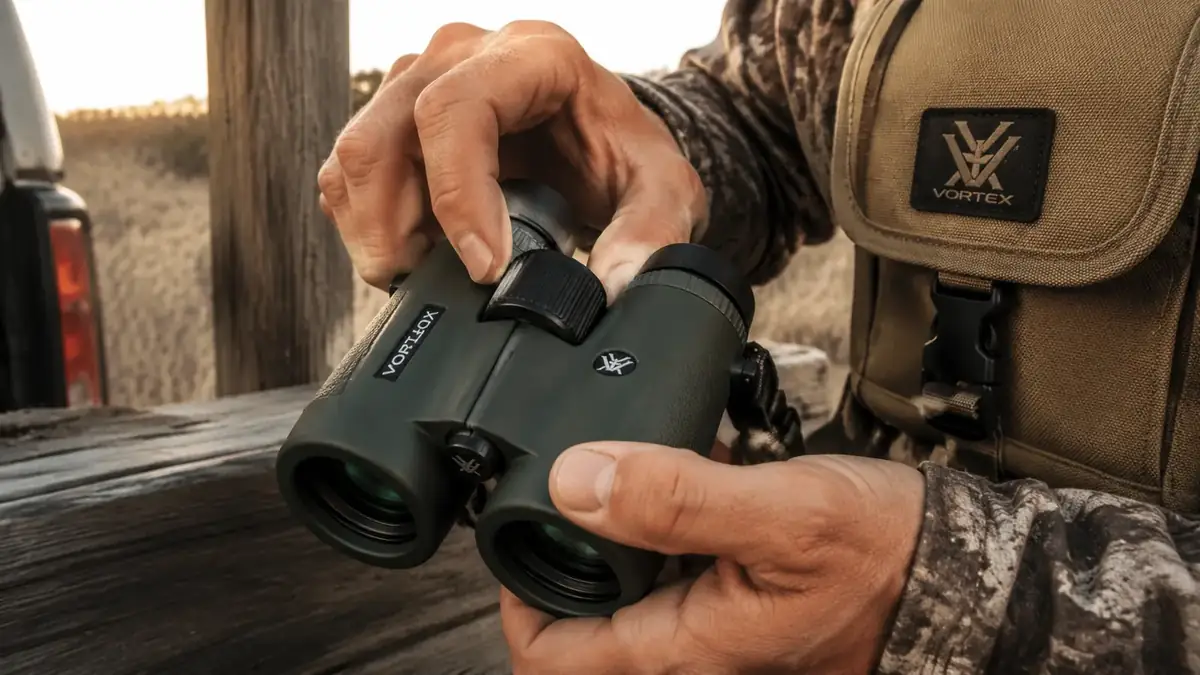
The objective lenses are the big lenses on the front, the ones facing whatever you're glassing. Bigger objective lenses gather more raw light before any of it even gets to your eye. A 42mm objective lens is about as big as you can go before the binocular starts turning into a boat anchor around your neck.
I've carried 50mm binoculars on a couple of western hunts where I was glassing open country from a truck or a fixed glassing point, and they do pull in more light. But they're heavier, bulkier, and honestly overkill for the kind of whitetail hunting most of us do here, sitting a stand or still-hunting a fence line where you're not covering miles of open country every day. For that kind of hunting, 42mm objective lenses hit the balance between light-gathering ability and something you can actually wear on a harness all day without your neck complaining by noon.
I've also handed a pair of 50mm binoculars to a buddy who hunts mostly from a box blind, and even he admitted the extra bulk wasn't worth it once he was climbing a ladder in the dark with a thermos in one hand. Match the objective lens size to how you actually hunt, not to whatever pulls in the most light on paper.
Step 3: Check the glass and coatings, not just the specs on the box
Two binoculars can share the exact same 10x42 spec sheet and perform completely differently in the field. The difference is glass quality and lens coatings, and this is where cheap binoculars really show their weakness right at dusk.
Look for fully multi-coated lenses, meaning every glass surface, not just the outer lenses, has anti-reflective coating applied. That coating cuts down on light lost to internal reflection and glare, which matters most exactly when light is scarce. HD glass, the kind Vortex builds into the Crossfire line, also cuts down on the color fringing you get around a deer's outline in dim light, that faint purple or green edge that makes it harder to separate an animal from brush behind it.
I learned this the hard way glassing a cedar break at last light with a pair of bargain binoculars years back. The spec sheet said 10x42, same as what I run now. In practice, everything past 150 yards turned soft and washed out the second the sun dropped behind the tree line. Coatings and glass quality are the part of the spec sheet that never shows up in a store's fluorescent lighting, only in the field.
One trick I use in the store, if the display lets you, is to look through the binoculars toward the darkest corner of the shop instead of straight at the front window. Cheap glass gets noticeably dimmer and grayer in that low light. Good HD glass holds contrast even in a dark corner, and that's the closest test you'll get to a real dusk sit without leaving the parking lot.
Step 4: Make sure the housing is actually sealed for real weather
Low-light hunting hours are also usually the coldest, wettest hours of the day. Morning dew, frost, a stand you climbed into before a front moved through, that's when a binocular with a weak seal fogs up on the inside where you can't wipe it clean.
Waterproof and fogproof aren't marketing words if the manufacturer backs them with an actual O-ring seal and nitrogen or argon purging inside the housing. That purge process replaces the air inside the binocular with dry gas, so there's no moisture in there to condense when the temperature swings, which it does every single morning I'm in a stand before sunrise. I've had a pair of unsealed binoculars fog up from the inside on a 34-degree November morning and stay fogged the rest of the hunt. That's a wasted sit, and those low-light sits are the ones you can least afford to waste.
I also carry my binoculars through more than just rain. They ride in the truck bed toolbox, get set down on wet grass, and take the occasional bump against a stand rail while I'm climbing in the dark. A rubber armor exterior over that sealed housing has saved my glass from a couple of drops I'd rather not admit to, and it's worth checking that the rubber wraps the whole body, not just the barrels.
Step 5: Weigh the whole package, not just the optics
A binocular you don't want to carry is a binocular that stays in the truck. I check total weight, and I check what it comes with. A binocular harness beats a neck strap every time once you've worn a strap digging into your neck for a six-hour sit, and a good harness keeps the binoculars up on your chest, ready, instead of banging around while you're climbing into a stand in the dark.
I also check the warranty before I buy, because glass gets dropped, fogged, or knocked against a stand rail eventually. An unconditional, no-questions warranty tells you the manufacturer expects their glass to hold up, and it means a hard bump on a ladder stand rail doesn't end the binocular's career. The Vortex Crossfire HD comes with that kind of warranty, along with a GlassPak harness in the box, and after a full season of hauling it up and down a ladder stand and through cedar breaks, I can say it's earned the confidence.
Weight matters more than most first-time buyers expect. A pair that feels fine handheld in a store for thirty seconds can feel a lot heavier after two hours of holding steady on a fence line at last light. I look for something under two pounds with the harness, light enough that my arms aren't shaking right when I need the steadiest hold of the whole sit.
What Else Helps
A rangefinder pairs well with a good pair of binoculars once you've spotted something worth judging, since range changes how you read antler mass and body size at distance. I also keep a simple lens cloth clipped to my harness, because a smudge on the objective lens does the same damage as bad coatings, it scatters light right when you need every bit of it. If you glass from a fixed stand or blind regularly, a tripod adapter is worth having too. Vortex binoculars, including the Crossfire, accept a standard tripod adapter, and holding steady glass on a tripod at last light beats fighting hand shake right when detail matters most. A soft rain cover for the objective lenses is worth the few dollars too, since a wet lens at dusk is nearly as bad as no binoculars at all.
The buck doesn't wait for better light. Your binoculars either work in the twenty minutes you've got, or they don't work at all.
Built for the light that actually matters
Every step above is baked into the Vortex Crossfire HD 10x42, HD glass, a real 4.2mm exit pupil, sealed waterproof and fogproof housing, and a harness that keeps it ready at your chest. It's the pair I trust when the light's running out.
Amazon Check Today's Price on Amazon →