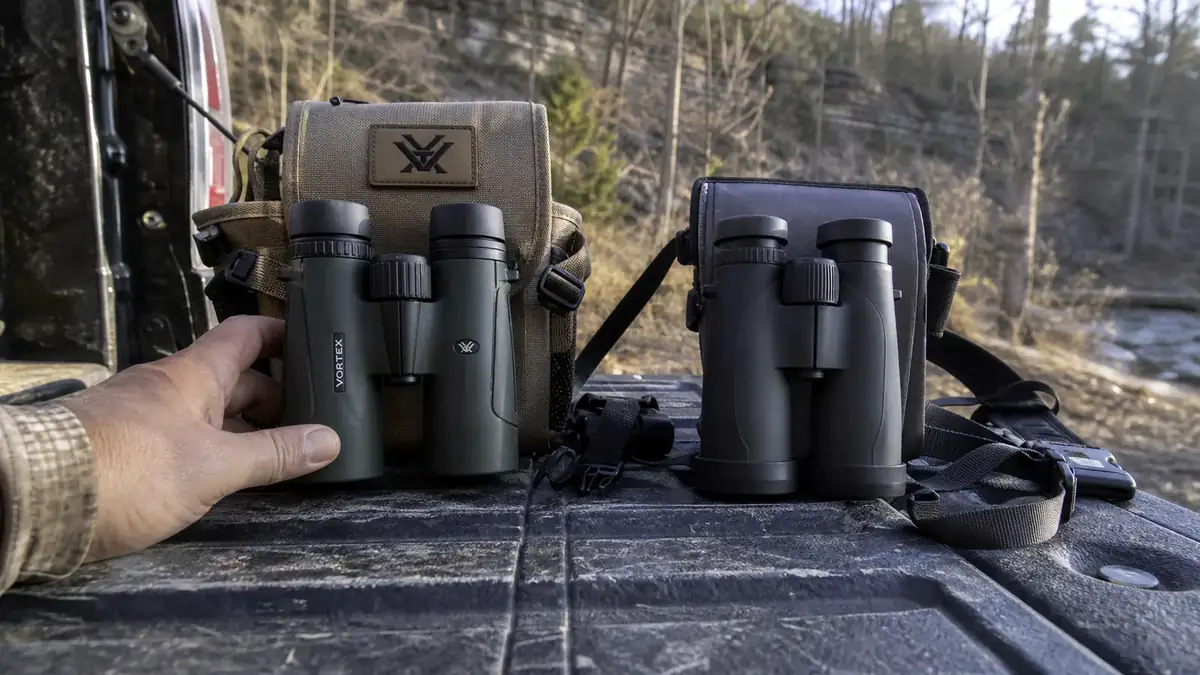
If you just want the short answer before I get into the weeds: I carry the Vortex Crossfire HD 10x42 in my truck bag from bow season clear through late rifle season, and it's the pair I hand a buddy who shows up without glass of his own. My brother-in-law runs the Nikon Prostaff P3 10x42, and I'm not going to sit here and tell you he made a bad choice, because he didn't. Both of these binoculars will get you through a full season of glassing cedar breaks and wheat field edges without letting you down. But they don't win in the same spots, and if you're trying to decide between them before opening weekend, you need to know where each one actually pulls ahead.
I've glassed with both of these side by side enough mornings now, sitting on the tailgate before first light, passing them back and forth between us, that I've got a real feel for where the differences show up. It's not a landslide either way. It's closer than you'd think given how the two are positioned in the market, and where you land probably comes down to how much weight you're willing to carry on your chest all day and how much you care about a warranty that never asks you a single question.
This isn't a spec-sheet comparison I pieced together from a manufacturer's website. My brother-in-law and I have hunted the same eighty acres of red dirt and cedar breaks outside of Ada for going on six years now, and we've made a habit of trading glass back and forth whenever we're set up close enough to whisper. Some mornings it's a hundred-yard difference between our two stands, other times we're both hunkered on the same fence line waiting on the same field edge. Either way, we've had plenty of chances to compare notes on the exact same deer, the exact same light, the exact same minute of the morning.
We didn't just compare them on one crisp fall morning either. Between the two of us we've run these binoculars through a hundred-degree August scouting trip, a sleeting late-November rifle sit, and everything in between. Both held their zero, both stayed fog-free through some real temperature swings when we'd climb down out of a warm truck cab into fifteen-degree air, and neither one has fogged up on the inside once, which is really all you can ask of a waterproof rating that gets printed on a box.
| Vortex Crossfire HD | Nikon Prostaff P3 | |
|---|---|---|
| Magnification | 10x | 10x |
| Objective Lens | 42mm | 42mm |
| Glass / Coatings | Fully multi-coated HD glass, brighter through the last legal light of the day | Fully multicoated optics, solid but noticeably dimmer at dusk |
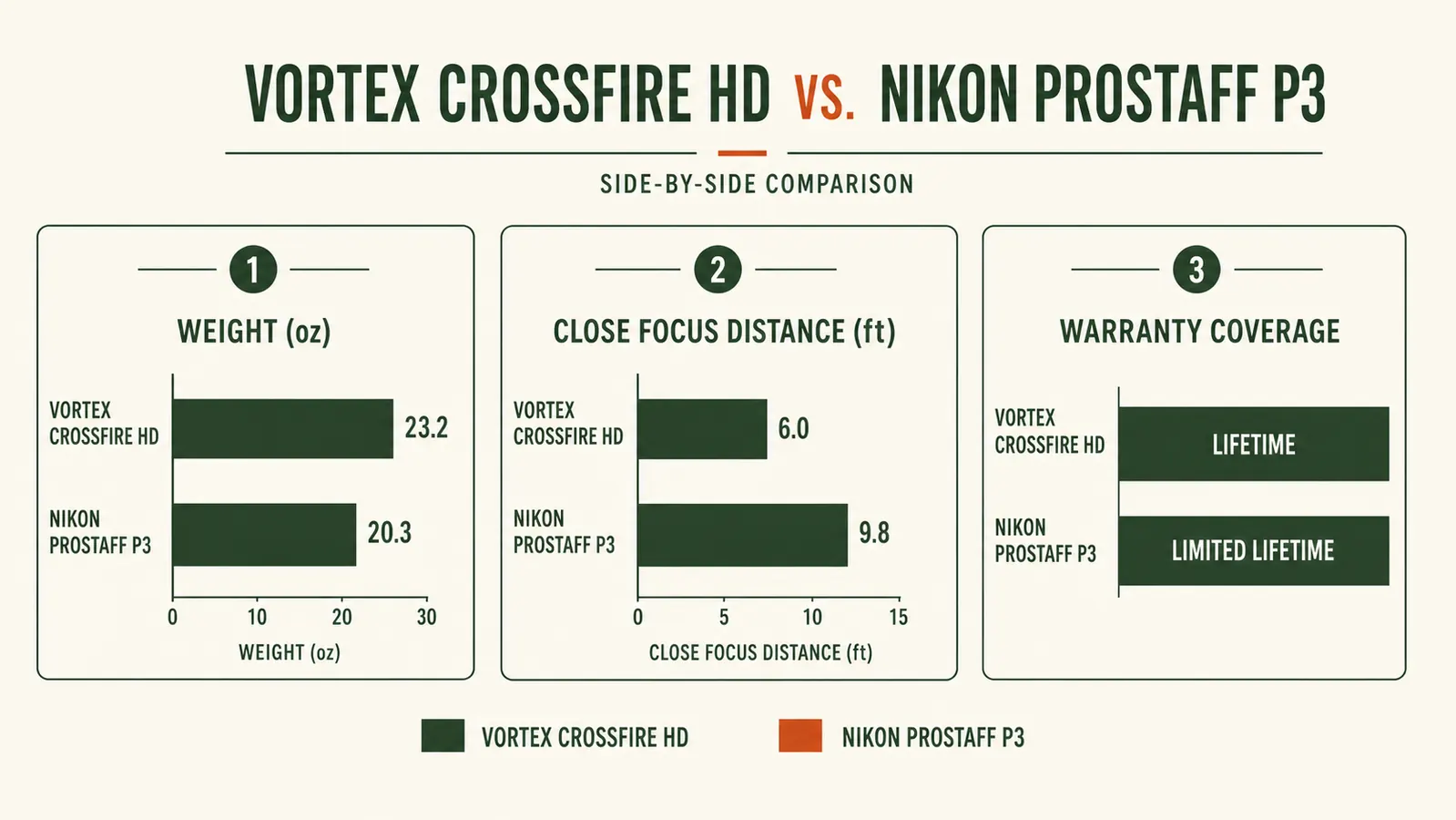
| Weight | 25.4 oz | 21.2 oz (lighter for all-day carry) |
| Close Focus | 6.5 ft | 9.8 ft |
| Warranty | Unlimited, unconditional, transferable, no receipt needed | 25-year limited warranty, standard terms |
| Waterproof / Fogproof | Yes, O-ring sealed, nitrogen purged | Yes, O-ring sealed, nitrogen purged |
| Best Use | All-day glassing from treestand to ridge line, worst-light hours | Lighter grab-and-go carry for shorter sits |
Where the Vortex Crossfire HD Wins
The first place the Crossfire HD pulls ahead is low light, and for me that's the whole ballgame. Deer move at first and last light around here more than any other time of day, and that's exactly when a cheaper pair of glass gives up the most detail. I've stood on the same fence line at 6:40 in the morning with both binoculars and watched the Crossfire HD hold color and edge definition on a buck's rack a good ten minutes longer into that gray pre-dawn window than the Prostaff did. It's not a dramatic gap. It's the kind of gap that matters when you're trying to decide if it's a shooter or a three-year-old before he steps behind a cedar.
The second place Vortex wins outright is the warranty, and I don't say that lightly because I've actually used it. I dropped an older pair of Vortex glass off a deer cart two seasons back, cracked a hinge, and they replaced it with no paperwork, no receipt, no argument. Nikon's 25-year limited warranty is fine as warranties go, but 'limited' means there are conditions attached, and Vortex's VIP warranty simply doesn't have any. When you're the kind of hunter who bangs gear against tree stands, truck doors, and rock ledges the way I do, that unconditional promise is worth real money on its own.
There's a third edge the Crossfire HD holds that doesn't show up on a spec sheet, and that's close focus. Mine will pull down to about six and a half feet, which sounds like a strange thing to care about until you're glassing a turkey working the edge of a food plot fifteen yards off your stand, or you're checking a rub for fresh sign without climbing all the way down. The Prostaff needs almost ten feet before it locks in clean, which means it's a little less useful for anything closer than mid-range. Small thing, but it adds up over a season of actual use.
The grip matters too. The Crossfire HD ships with a rubber armor that stays tacky even when your hands are cold and wet, and the included GlassPak harness keeps the weight off your neck and centered on your chest, which I've come to appreciate on longer sits. I've had plenty of binoculars over the years that turned into a slick brick the second a light rain rolled through. This one hasn't.
I wear glasses for distance, and eye relief is one of those things you don't think about until it ruins your morning. The Crossfire HD's eye cups twist out to a position that lets me keep my glasses on and still get the full field of view without a black ring closing in around the edges. It's a small detail, but if you're one of the growing number of hunters glassing with your readers or your prescription sunglasses still on, it's worth testing both in person before you buy either one.
Where the Nikon Prostaff P3 Wins
My brother-in-law's biggest argument for the Prostaff, and it's a fair one, is weight. Four ounces doesn't sound like much until you've had a pair of binoculars bouncing on your chest for six hours of a spot-and-stalk hike through the Wichita Mountains. He does more walking hunts than I do, and he notices that difference by the time he's a mile and a half in. If your season looks more like long hikes and less like sitting still in a blind, that lighter body is a legitimate advantage, not a marketing footnote.
The Prostaff also tends to be the more affordable way into a real name-brand 10x42, which matters if you're outfitting more than one person in the family or you just don't want to spend big on your first serious pair of hunting glass. It's a fully capable binocular for daytime glassing, wheat field edges, and general scouting work where you're not fighting the absolute last minutes of shooting light. Nikon didn't cut corners on the build, they just made different tradeoffs than Vortex did, and for a lot of casual hunters those tradeoffs land just fine.
I'll also give Nikon credit on barrel width. The Prostaff's chassis runs a touch slimmer than the Crossfire HD's, and my sister, who's got smaller hands than either of us, says it's noticeably easier for her to get a solid grip on for longer stretches. If you're buying for someone with smaller hands, or you just prefer a trimmer body, that's worth factoring in before you decide.
There's also something to be said for the Nikon name carrying real weight if you ever decide to sell or trade a pair down the line at a gun show or to a hunting buddy who's just getting started. It's a recognizable brand outside of the hunting-optics crowd specifically, which isn't nothing when you're trying to move used gear at a fair price.
Still glassing through last season's dim, yellow-tinted pair when the real bucks show up?
That gray window at first and last light is when the biggest deer move, and it's exactly when cheap glass falls apart on you. The Vortex Crossfire HD is the pair I actually load into my truck bag every single morning of the season.
Amazon Check Today's Price on Amazon →
Who Should Buy Which
If you hunt mostly from a stand or a blind and you're out there for the worst-light hours, dawn and dusk, when the biggest bucks are willing to move in the open, get the Vortex Crossfire HD. The brighter glass and the no-questions-asked warranty are worth carrying the extra few ounces for. If your season is built around long hikes, spot-and-stalk country, or you're buying a first pair of real glass for a kid or a spouse who just needs something solid and light for daytime scouting, the Nikon Prostaff P3 will serve you well and won't feel like dead weight on a long walk.
I'd also point out that these aren't mutually exclusive purchases if you're outfitting a whole hunting party. My brother-in-law and I have gone back and forth about it plenty of times, and we've landed on keeping one of each in the family truck. He grabs the Prostaff for morning scouting walks around the property line, I keep the Crossfire HD in my stand bag for the sits that matter, opening morning, the last hour of legal light, the mornings after a cold front when the deer are moving early. Neither of us feels like we got the short end.
If you're buying a gift for someone just starting out, a teenager headed on their first youth hunt or a spouse who's finally coming along, either one is a fine choice and beats the department-store glass most beginners start with by a country mile. I'd lean Prostaff there simply because it's lighter in a young hunter's hands and a little more forgiving to grip for a first-timer still learning to hold steady on a moving target.
Bottom line, and I mean this the way I'd say it standing at the tailgate with you: if you can only own one pair and you want it to perform in the hours that actually put deer on the ground, take the Crossfire HD. If weight and a lower cost of entry matter more to you than squeezing every last minute out of legal light, the Prostaff won't let you down either. Neither one is the wrong answer. I just know which one is sitting on my dash right now.
Don't let another opening morning pass with glass that quits on you at first light.
The Vortex Crossfire HD 10x42 is what I hand anyone in my truck who forgot their own binoculars. Unlimited warranty, brighter glass in the dark hours, and it's held up to every hard knock I've given it.
Amazon Check Today's Price on Amazon →